Week 5 recap — Colossians 1:15–20
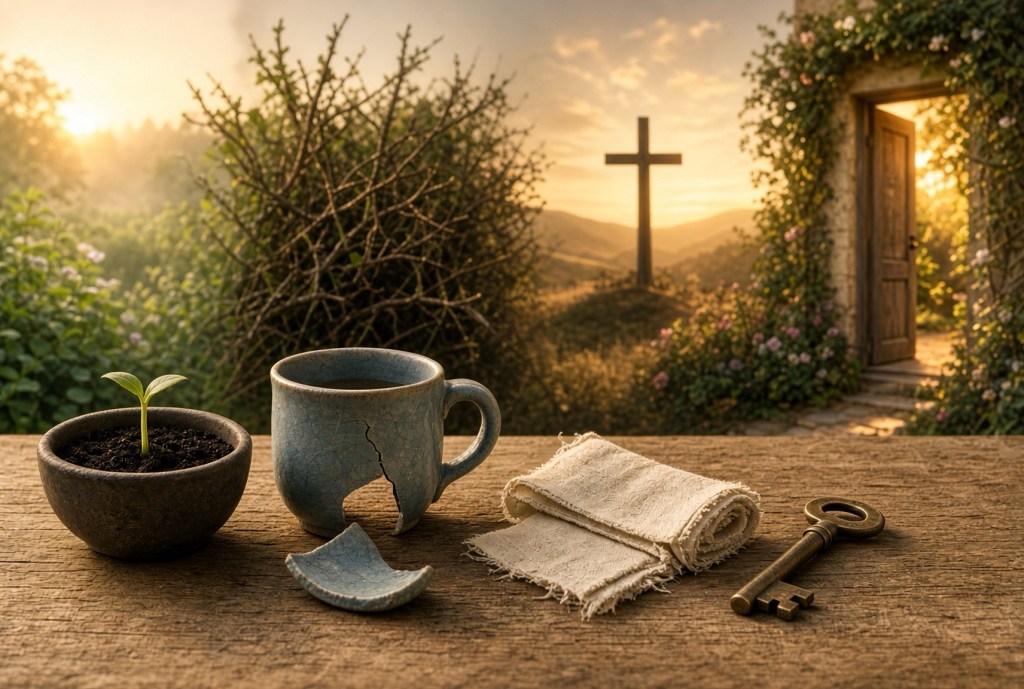
A seed. A broken mug. A bandage. A house key.
On their own, the four objects do not say much. Set them in an order and give them two minutes, and a group can make them into a story: something planted, something shattered, something mended, something that opens a door again. The objects do not change. What changes is that they now belong to one plot. Knowing the ending rewrites the earlier pieces. The crack in the mug is no longer a random accident. It is the moment the story needed.
That was the icebreaker. It was also the point of the hour.
Before we opened the details of Colossians 1:15–20, we set the passage inside the Bible’s one overarching story. A metanarrative is the large, unifying story that gives the individual books, events, and teachings of Scripture their meaning. The Bible is not mainly a collection of disconnected moral lessons. It tells the true story of God’s work to create, redeem, and restore his world through Christ. Types and shadows along the way only make sense once you can see where the story is going. And the story, from the first page, is aimed at a Person.
The story the hymn is standing inside
We traced four movements, and then we listened for them in the text.
Creation. God created all things good, ordered them under his rule, and made humanity in his image to live in fellowship with him and to exercise faithful stewardship (Genesis 1–2). The note on the creation panel was the simplest and the most important: it is good. Colossians does not treat the material world as a mistake to escape. It identifies the Son as the One through whom and for whom all things were created.
Fall. Human rebellion brought alienation, death, and disorder into God’s good creation (Genesis 3). Sin damages humanity’s relationship with God, with one another, and with the created order. The world does not need a better self-improvement plan. It needs reconciliation and renewal.
Redemption. God’s covenant promises move the story toward Jesus, the incarnate Son. Through his life, death, and resurrection, Christ defeats sin and death, reconciles enemies to God, and begins the new creation. In this passage the Creator is also the Redeemer who makes peace through the blood of his cross.
Restoration. God will bring his purposes to completion by renewing creation and dwelling with his redeemed people (Revelation 21–22). Christ’s resurrection is the beginning of that restored world. As “firstborn from the dead,” he is both the guarantee and the ruler of the new creation.
The teaching connection was simple: listen for creation in verses 15–17, redemption and new creation in verse 18, and reconciliation moving toward restoration in verses 19–20. The central figure in every movement is Christ. The One through whom the story begins is the One through whom God brings the story to its intended end.
From prayer to hymn, without a break
Colossians 1:15–20 is the doctrinal center of the letter, and it is often described as poetic or hymnic. Scholars debate whether Paul composed it for this letter, adapted earlier material, or simply wrote in an elevated style. For our purposes the debate can stay in the background. Whatever its origin, every line functions here as apostolic teaching.
Two observations from the margins mattered as much as the commentary.
First, there is no break between the prayer and the hymn. Paul has been thanking God for the Colossians and praying that they would be filled with the knowledge of his will. Then he says that the Father has rescued them from the domain of darkness and transferred them into the kingdom of his beloved Son, in whom we have redemption, the forgiveness of sins (1:13–14). The next word is “He.” The “He” is Jesus. The prayer rises into praise without changing the subject.
Second, the scope is relentless. “All things” appears five times. “Everything” appears once. The claim is not large. It is total.
That claim also answers the pressure the letter is written against. The precise identity of the Colossian error is debated, but Paul names the pressures himself: teachings that take people captive through philosophy and empty deceit, Jewish calendrical observance, ascetic practices, visions, the worship of angels, and speculation about cosmic powers (Colossians 2:8, 16–23). His answer is not a longer list of spiritual techniques. It is a Person. Every created power stands under the Son. Nothing can supplement him, and nothing can rival him.
The image of the invisible God
He is the image of the invisible God, the firstborn of all creation. — Colossians 1:15
“Image” here is not a rough likeness. Jesus is the exact image of the Father. Genesis 1:27 says humanity was made in God’s image; Colossians 1:15 says the Son is the image. The difference is the whole gospel. We reflect. He reveals. Jesus said it without ornament: “Whoever has seen me has seen the Father” (John 14:9).
That is a pastoral sentence, not only a doctrinal one. When we want to know what God is like, we look first at Jesus’ words, his compassion, his holiness, and his cross — not at inner impressions, nature mysticism, or the cultural portraits of “the divine” currently on offer. A rival picture of God, whether therapeutic, political, or purely philosophical, becomes an idol the moment it is detached from the Jesus of the Gospels.
It is also the right answer to a sentence many of us have heard: “I believe in God, just not organized religion.” The God of the Bible has organized his self-disclosure around a particular person. Faith is not a mood aimed at an unnamed mystery. It is trust in the Son who makes the invisible God known.
Firstborn does not mean first made
The second half of verse 15 has been misread for a long time, and the misreading is still alive. “Firstborn of all creation” does not mean “the first creature God made.” The next verse will not allow it. “For by him all things were created… all things were created through him and for him.” A creature cannot be the agent through whom every creature, visible and invisible, came to be. John says the same thing from the other side of the canon: “All things were made through him, and without him was not any thing made that was made” (John 1:3).
“Firstborn” in this text is the language of rank and inheritance, not of chronology. Scripture itself uses the word that way. Israel is called God’s firstborn in Exodus 4:22, not because Israel was the first nation on earth, but because Israel was God’s heir and covenant people. David is called firstborn in Psalm 89:27 — “I will make him the firstborn, the highest of the kings of the earth” — and David was not Jesse’s oldest son. To call someone firstborn, in this sense, is to name the heir. It is to say who receives the inheritance, and who stands first.
That reading also marks a line between the faith of this letter and other accounts of Jesus that use the same verse to mean something else. Where the passage is taken to mean that there was a time when the Son was not, or that he is a lesser divine being through whom Jehovah made everything else, the “for” of verse 16 has been set aside. Where he is cast as the eldest spirit brother of the human family, who attained what the Father is and invites others to attain it in kind, the Creator–creature line that Paul draws has been erased. The hymn will not bear either reading. The Son is uncreated. Believers are adopted children, not siblings of Christ by nature. No one becomes what he is.
Keep reading. The verse that is sometimes used to shrink him is the verse that enthrones him.
Creator, sustainer, preeminent
Three claims sit on top of one another, and the third is the point of the other two.
He is the Creator. By him all things were created, in heaven and on earth, visible and invisible, whether thrones or dominions or rulers or authorities. The powers that fascinated Colossae are not his rivals. They are his workmanship, and they were made for him.
He holds all things together. “In him all things hold together” (1:17). R. C. Sproul’s line belongs here: there are no maverick molecules. Not one atom is on an unsupervised errand. A human body alone is on the order of a septillion molecules, and every one of them continues because the Son upholds what he made. We had already touched providence earlier in the study. Here it becomes personal. Coherence is not a feature of the universe. It is a Person.
He is preeminent. The word in verse 18 means paramount rank, dignity, and importance. Highest rank is not a compliment. Highest rank means he is worthy of worship. The hymn is moving toward that confession the whole way.
This is also where the text speaks to a frightened week. When life feels as if it is coming apart — illness, institutional collapse, family fracture — Colossians 1:17 does not promise that you will hold it together. It locates coherence in Christ. That is a check on deism, the idea that God wound the universe and walked away. It is equally a check on panic, the idea that everything depends on my control. And it funds a Christian approach to science rather than a rivalry with it. Physical laws are not competing explanations of the world. They are descriptions of how the Son ordinarily upholds what he made.
Trusting that sustaining rule is not the same as becoming passive. Stewardship was given in a good creation. Prayer, work, medicine, repentance, and ordinary faithfulness remain ours. What is no longer ours is the illusion that we are the ones keeping the world from flying apart.
Head of the body, firstborn from the dead
And he is the head of the body, the church. He is the beginning, the firstborn from the dead, that in everything he might be preeminent. — Colossians 1:18
The transition is natural, and it is pastoral. The next section of the letter turns fully to the gospel as it lands on a people. Before it does, Paul names the church. Christ is not an idea the church hosts. He is its head. The body does not supply the head with a mind. The head gives the body its life and its direction.
“The beginning, the firstborn from the dead” is resurrection language. The same title that named him heir of creation now names him heir of the new creation. Easter is not a postscript to the hymn. It is the hymn’s second peak, and the reason the rank is his. The One who made all things has passed through death and come out as the first of a new humanity. What he is, his people will be. What he rules, he will renew.
Fullness, and a peace that is not thin
For in him all the fullness of God was pleased to dwell, and through him to reconcile to himself all things, whether on earth or in heaven, making peace by the blood of his cross. — Colossians 1:19–20
“Fullness” is restated more explicitly two verses into the next chapter: “In him the whole fullness of deity dwells bodily” (Colossians 2:9). The claim is not that Jesus received a large share of divine qualities. It is that God was pleased to have all his fullness dwell in the Son. Pleased. The incarnation and the cross are not a reluctant rescue. They are the Father’s delight.
That closes the door on the Colossian temptation, and on ours. Do not look for a second fullness — a later experience, a stricter rule-set, a secret wisdom, a supplement that will finally make you complete, secure, spiritual, or acceptable. Achievement, approval, politics, romance, knowledge, discipline, and spiritual experiences all offer themselves for the role. None of them can dwell with the fullness that already dwells in Christ. Colossians 2 will press the point harder. Week 5 only has to see it.
Verse 20 raises an honest question, and the letter answers it before the question can wander off. “Reconcile to himself all things” is not a doctrine of universal salvation. Paul applies the reconciliation, in the next breath, to believers who were formerly alienated and hostile, and who continue in the faith, stable and steadfast (1:21–23). Colossians 3:6 still speaks of the wrath of God coming upon disobedience. The scope of the peace is cosmic: every enemy power is put in its place, and heaven and earth are brought back under their rightful Lord. The invitation of the peace is particular: formerly alienated, now reconciled, if you continue in the faith. Fall and redemption are still in the story. The cross did not make judgment fictional. It made peace for enemies, by blood.
Two further notes belong with that peace, and they have to be held together.
Reconciliation with God is already accomplished at the cross. Our part is to receive it, and then to become peacemakers in the relationships and systems we actually inhabit. If a relationship, a habit, or a fear sits outside that peace, the passage does not shrug. It holds out 1:21–23 and tells the truth about what we were, what we are, and what continuing looks like.
Care for creation and the pursuit of justice are not add-ons. If Christ made peace “whether on earth or in heaven,” then fractured human and non-human relationships lie within the horizon of his work. The church simply refuses to confuse that work with every political program that borrows its vocabulary. His peace is larger than our platforms, and more demanding than our slogans.
Someone in the room called this one of the greatest paragraphs in the history of the world. That is not too much to say. It is a historic pastoral prescription for a cold or crowded heart, which is why memorizing 1:15–20 is not a children’s exercise. It is how a church keeps the real Christ in front of her when other portraits start to look useful.
What preeminence looks like on an ordinary week
We closed by asking each person to name one area in which Christ’s preeminence needs to become more visible this week, and by praying that the word of Christ would dwell richly in the group, that he would have first place in our choices, and that his reconciling peace would shape our relationships.
The four objects are still ordinary. A seed, a broken mug, a bandage, a house key. Laid inside this paragraph, they stop being a party game. The seed belongs to the One through whom all things were made, and through whom a new creation has begun. The broken mug belongs to a world that was good and is not whole. The bandage belongs to a peace made by blood, not by denial. The key belongs to the heir — the firstborn, not the first made — who opens what he made, holds it together, and will dwell with his people when the story reaches the end he always intended.
The pictures did not change. The story did.


Leave a comment