WEEK 4 SESSION RECAP
Paul’s Prayer for the Colossians · Colossians 1:9–14
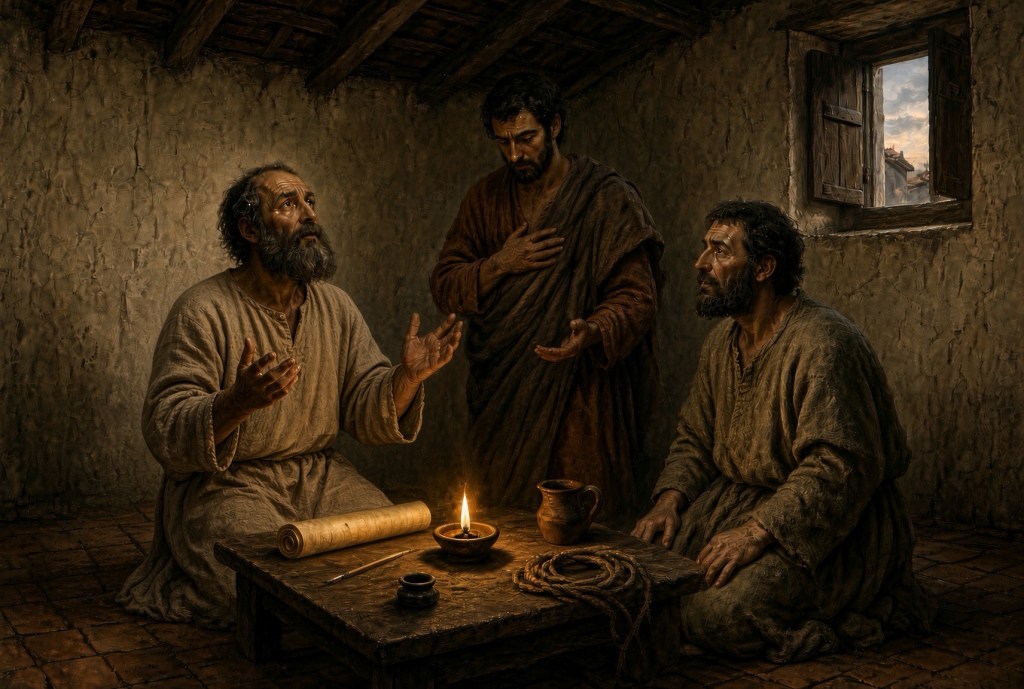
Tonight we sat inside one of the most complete prayers in the New Testament. Paul is writing from prison to a young church he did not plant, a congregation already marked by faith, love, and hope—and already being courted by a spirituality that offered extra rules, extra visions, and a smaller Christ. Before he sings the great hymn of the Son in 1:15–20, he does two pastoral things: he thanks God for how the gospel began among them (1:3–8), and he tells them how he prays for how the gospel continues (1:9–14).
The prayer is not a warm-up. It is the doorway. If Jesus is as supreme as the next paragraph will say, this is the kind of life that should grow in His people.
Where the Prayer Sits
Epaphras planted the church in Colossae, then brought Paul a report. Paul does not wait for a crisis to intercede. He prays because the gospel has already begun to bear fruit and he wants that fruit to fill the whole field. “And so, from the day we heard…” reaches back to good news, not bad news. Faithful ministry prays for people who are already doing well.
One of the questions that framed the night was deceptively simple: when you think about following God, do you usually want a GPS or a compass? A GPS promises the next turn—what job, which city, whom to marry. A compass orients you to true north so you can walk faithfully through terrain the map has not yet named. Paul’s prayer is compass work. He asks God to fill them with the knowledge of His will so they can walk, not so they can download a schedule. God is still sovereign but we are nonetheless called to walk in light of the knowledge of His will.
One Sentence of Pastoral Logic
We read Colossians 1:9–14 as one movement, not seven slogans. Prayer and doctrine are not two rooms in this letter. They are braided. The petitions rise out of the gospel already received, and the gospel statements at the end are the reason the petitions can be bold. You cannot mark a clean “prayer ends here” line. The asking and the announcing belong to each other.
The logic runs like this. Gospel news becomes unceasing intercession. That intercession asks for an inner filling that produces an outer walk. The walk is marked by fruit and by a still-growing knowledge of God. That life is held up by God’s own power—not for spectacle, but for endurance, patience, and joy. Thanksgiving then overflows, because the Father has already qualified them. Under the whole sequence is rescue, transfer, redemption, and forgiveness in the beloved Son.
Two guiding convictions for the whole night
Paul will not settle for a congregation that can repeat true sentences about Jesus while remaining unshaped in desire, walk, fruit, and endurance.
He also will not settle for a congregation that tries to produce a worthy walk by grit. The engine is spiritual filling. The atmosphere is thanksgiving and joy. The foundation is the finished work of the Son.
What We Traced in the Text
Unceasing prayer after good news · 1:9a
“We have not ceased to pray for you.” The word “ceased” is not merely about frequency. It points toward a God-consciousness—thoughts so occupied with the Father’s work in people that intercession becomes the air the minister breathes. Paul prays for a church that is already bearing fruit. That corrects a habit many of us have: we reserve serious prayer for collapse. Faithful ministry also leans in when the report is good, because fruit is meant to fill the field, not stop at the first ripe cluster.
Filled—not informed · 1:9b
The request is not that they would collect more religious data. Paul asks that they be filled with the knowledge of God’s will in all spiritual wisdom and understanding. “Filled” is the image of a fishing net crammed until there is no unused mesh—completely full, with no spare room for a rival occupancy. The Greek behind “knowledge” (epignōsis) is lived, personal knowledge. Wisdom is skill in living before God. Understanding is the ability to discern what a moment actually requires. Both are spiritual gifts, not products of a sharper notebook.
That is why “the will of God” in this prayer is larger than next Tuesday’s decision. Scripture already names stretches of that will with surprising concreteness:
- Sanctification and holy self-control — 1 Thessalonians 4:3–4
- Rejoice always, pray without ceasing, give thanks in all circumstances — 1 Thessalonians 5:16–18
- Do good so that ignorant talk is silenced, and live as free servants of God — 1 Peter 2:15–16
God’s will is first about who we are becoming and how we inhabit ordinary life. Specific guidance about work or marriage is not banned; it is simply not the center of Paul’s ask. He wants their inner life so saturated that motives, instincts, and choices start to answer to the Lord.
Knowledge that travels into the feet · 1:10a
They are filled so as to walk in a manner worthy of the Lord, fully pleasing to Him. Doctrine is never an end in itself here. Truth is meant to reach the pattern of a life—speech, money, anger, work, hidden choices, the Monday that follows Sunday. “Worthy” does not mean “good enough to earn Him.” It means a life that fits the worth of the One who already owns us. “Fully pleasing” raises the aim from avoiding scandal to delighting the Lord in every sphere.
In Colossae this was also strategy. False teaching offered special knowledge as a badge. Paul insists that real knowledge shows up as a path. If it does not change the walk, it is not the knowledge he is praying for. The searching confession is often not “I did not know,” but “I did know, and I still preferred another master in that room of my life.”
Fruit and increase, together · 1:10b
Bearing fruit in every good work and increasing in the knowledge of God are present-tense twins. The Christian life is a living tree, not a finished product after conversion. “Every good work” refuses a spirituality that only counts church jobs as fruit. Scripture’s fruit includes character, useful deeds, and people coming to faith. Knowledge is not left behind once ministry starts. Obedience becomes a classroom. We meet God in the places we trust Him.
The loop runs both ways. Deeper knowledge of God’s generosity loosens a tight fist; giving then teaches the giver more of the Father’s heart. Neglect of the Word starves good works of direction. Neglect of good works turns knowledge into pride. Either half alone becomes a distortion: barren study or rootless activity.
Power for staying · 1:11
They are strengthened with all power, according to His glorious might—the same might that raised Christ—for all endurance and patience with joy. The Greek word behind “power” is dynamis: real capacity, not pep talk. What surprised the room is the purpose. Divine power is not first an escape hatch, a platform, or a spectacle. It is given so that people can remain faithful when circumstances do not yield (endurance) and when people are slow, sharp, or disappointing (patience), and to do both with joy rather than grim stoicism.
Endurance, in that light, is not merely surviving. It is a kind of victory—staying under the weight without surrendering the soul. This verse reeducates many prayer lists. We may keep asking for the hardship to lift. Jesus asked that the cup pass; Paul asked that a thorn be removed. What changes is the second line: and if it remains, strengthen me to endure, make me patient with the people involved, and give me a joy that is not hostage to the outcome. God may be answering “strengthen them” when we were only asking “remove this.”
Thanks because we are already qualified · 1:12
Thanksgiving is not a polite add-on. It is part of the worthy walk. The key verb is qualified. The Father makes His people fit to share the inheritance of the saints in light. The tense points to a completed act with ongoing results. We do not work toward admission into the estate; we work from it.
That cuts two ways. It humbles the impressive: you did not qualify yourself. It lifts the ashamed: you are not disqualified by your inability to make yourself worthy. Self-qualification produces pride, despair, and comparison. The Father’s qualification produces gratitude, security, and welcome for weak saints. Light here is not mood lighting. It is the moral and relational realm of God’s holy people—the same light Paul was sent to open eyes toward.
Delivered and transferred · 1:13
Salvation is described with two decisive verbs: delivered and transferred. Conversion is not self-improvement inside the old country. It is extraction from a dominion and relocation under a new King. The “domain of darkness” is real—ignorance of God, bondage to sin, hostile powers, and a night that cannot generate its own dawn. The new address is the kingdom of the Father’s beloved Son. To belong to the kingdom is to belong to Jesus.
Paul’s own commission in Acts 26:17–18 uses the same map: open eyes, turn from darkness to light and from the power of Satan to God, receive forgiveness and a place among the sanctified. Ephesians 5 says we were darkness and now are light in the Lord, and calls us to walk as children of light, discerning what pleases Him. Darkness still harasses transferred people. It is no longer their government.
Daily discipleship, then, is ordinary citizenship: speech, work, forgiveness, justice, worship. We do not visit the kingdom on Sundays. We wake up already in it. Old loyalties—image, money, appetite, family idolatry, political belonging—are not small extras. They are rival flags.
In the Son we already have · 1:14
Everything lands “in whom.” Filling, walking, fruit, power, qualification, rescue, and transfer are not a self-help staircase. They rest on union with Christ. Redemption is exodus and marketplace language: release by payment. Forgiveness of sins is the personal center of that release, so no one can claim a cosmic salvation that leaves guilt untouched. “We have” is present possession. The debt is already canceled. The prison door is already open.
That is why the prayer can be bold, and why growth and struggle both need the same sentence. Pride says, “My fruit proves I am the qualified one.” Despair says, “My lack of fruit proves I cannot be His.” Both forget verse 14. The mature saint needs forgiveness as truly as the new one. Struggle does not rewind the transfer. Conviction is not condemnation. Memory is the discipline: we remember Christ so that pride is punctured and despair is answered.
I am growing, and I still live by redemption. I am struggling, and I already have forgiveness. Both halves are true at once.
A sentence the group was invited to practice
What the Passage Is Forming in Us
At the largest level, Colossians 1:9–14 teaches how a gospel people are formed. Four claims ran under the whole hour:
- Knowledge is more than information. The goal is discernment and desire, not a fuller notebook.
- The Christian life is organic, not modular. Filling, walking, fruit, power, thanks, and redemption belong together. Pull one out and the prayer collapses into activism or abstraction.
- Power is for staying, not only for escaping. God’s glorious might trains endurance, patience, and joy.
- Grace is the ground, not the prize at the end. Qualification, rescue, transfer, redemption, and forgiveness are given in the Son before the worthy walk is asked for.
Those four claims also confront the usual leans of a group. Some love study and underplay obedience. Some love activity and underplay communion. Some treat prayer as a tool for rearranging circumstances. Some treat hardship as evidence that God is absent. Some quietly believe they must finish qualifying themselves. This paragraph speaks to all five without turning the night into diagnosis of people rather than exposition of Scripture.
The Big Idea We Carried Out
Paul asks God to fill believers with a Spirit-given knowledge of His will so that their whole walk fits the worth of the Lord—fruitful, growing, durable, patient, and joyful—because the Father has already qualified them and the Son has already redeemed them.
How the Night Closed
Paul does not pray that the Colossians would become impressive. He prays that they would be filled. Knowledge is meant to reach the walk, the walk to become fruit, the fruit to keep company with still more knowledge of God, and hardship to be met with God’s own strength. Then he reminds them why any of that is possible: the Father has already qualified them, already rescued them from darkness, already moved them into the kingdom of His beloved Son, in whom they already have redemption and the forgiveness of sins.
We do not study this prayer in order to impress God. We receive it because we already belong to the Son.
The wrap question remains open for the week: looking at the whole prayer—filling, walk, fruit, strength, thanksgiving, transfer, redemption—which petition do you most need someone to pray for you, and why?
Ways to Keep Walking
- Pray Colossians 1:9–14 daily for one person in the group and one person who is not in the room.
- Write a two-line prayer that includes both a circumstance request and a formation request.
- Name one place where knowledge and walk have drifted apart, and take one visible step of obedience before we meet again.
- When hardship hits, add the words “strengthen me for endurance and patience with joy” before you only ask for the hardship to end.
- Memorize verses 13–14 as an identity sentence: delivered, transferred, redeemed, forgiven.
A Prayer to Carry
Father, from this day we hear these words, do not let us cease to pray them. Fill us with the knowledge of Your will in all spiritual wisdom and understanding. Teach us to walk in a manner worthy of the Lord, fully pleasing to Him, bearing fruit in every good work and increasing in the knowledge of God. Strengthen us with all power, according to Your glorious might, for all endurance and patience with joy. We give thanks to You, for You have qualified us to share in the inheritance of the saints in light. You have delivered us from the domain of darkness and transferred us to the kingdom of Your beloved Son, in whom we have redemption, the forgiveness of sins. Let the word of Christ dwell in us richly. In the name of the beloved Son. Amen.
 Immerse Bible Study
Leave a comment