This past Sunday night at Oakland First Baptist Church, we began our Immerse Bible study through the book of Colossians. For those who were unable to join us, here is a thorough recap of the evening so you can stay connected and prepared as we continue.
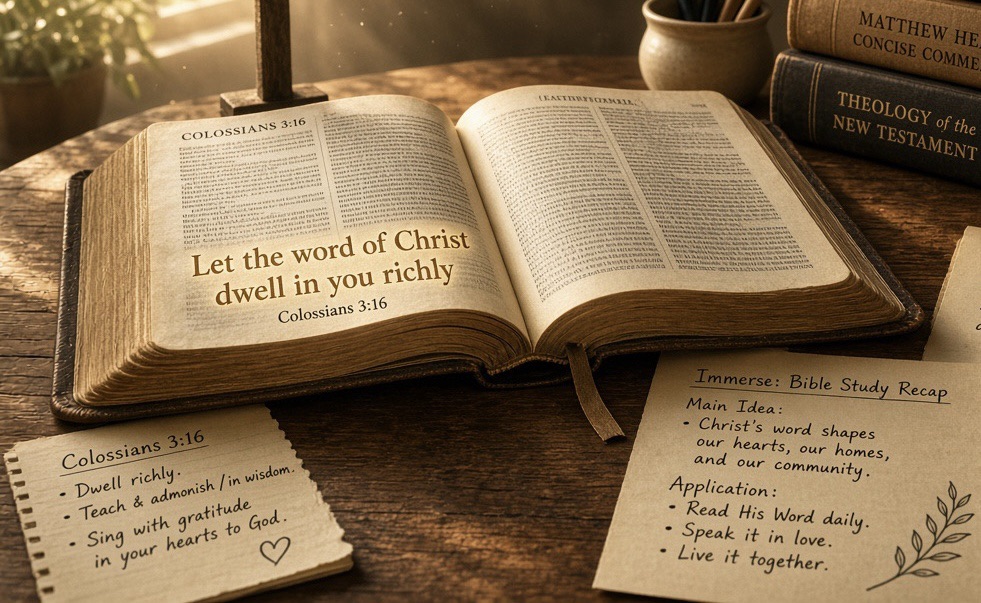
Our goal for this study is not merely to gain more information about Scripture. It is to let the word of Christ dwell in us richly—exactly as Colossians 3:16 commands. That verse serves as the overarching theme and aim of Immerse: “Let the word of Christ dwell in you richly, teaching and admonishing one another in all wisdom, singing psalms and hymns and spiritual songs, with thankfulness in your hearts to God.” Everything we explored Sunday night pointed toward this reality: knowledge of God’s Word that leads to obedience, and obedience that shapes us into greater Christlikeness.
From Salvation to Christlikeness
We began by connecting the morning sermon to the evening study. Josh preached from Mark 11:15–19 on Jesus clearing the temple. He asked us to consider that believers are now the dwelling place of the Spirit (Romans 8:9–11; 1 Corinthians 6:19; 2 Timothy 1:14; James 4:5). As God’s temple, what “tables” in our lives still need to be overturned?
From there we traced a clear progression:
- Salvation — Saved by grace through faith in Christ (Ephesians 2:8–9).
- Indwelling Spirit — God’s Spirit takes up residence in us (Romans 8:9–11; John 14:15–17).
- Indwelling Word of Christ — The word of Christ dwells in us richly (Colossians 3:16).
- Obedience — The Spirit and the Word bear fruit in how we live.
- Believers looking more like Christ — We are transformed into His likeness (2 Corinthians 3:18).
Salvation makes us God’s temple. The Spirit and the word of Christ dwell within. When we obey what we learn, that obedience shapes us into His likeness. Knowledge alone is never the finish line. Scripture insists that true knowledge produces a walk worthy of the Lord.
Putting Off the Old Self and Being Renewed in Knowledge
Colossians 3:9–10 declares that we “have put off the old self with its practices and have put on the new self, which is being renewed in knowledge after the image of its creator.”
R.C.H. Lenski put it sharply: the old man is not converted or renewed—he can only be replaced by a creative act of God. John MacArthur emphasized the practical path: we are renewed in the spirit of our minds as we accept the knowledge God gives, appropriate it, and allow it to fuel growth into righteousness and true holiness. The new self is not static; it is “being renewed in knowledge.”
This raises a vital distinction: What is the difference between knowledge and wisdom? Knowledge involves grasping truth. Wisdom is the right use of that knowledge in daily life. Charles Spurgeon said it well: “Wisdom is the right use of knowledge. To know is not to be wise. Many men know a great deal, and are all the greater fools for it… But to know how to use knowledge is to have wisdom.” Other voices across church history—Augustine, Calvin, Aquinas, Tozer, Sproul, Piper, and Packer—echo the same theme. True wisdom begins with the fear of the Lord, is rooted in Christ, and issues in humble, obedient living.
Letting the Word Dwell Richly
Colossians 3:12–16 calls us to put on compassionate hearts, kindness, humility, meekness, patience, forgiveness, and love, and then climaxes with the command: “Let the word of Christ dwell in you richly.” The word is not to visit occasionally. It is to inhabit us copiously—abundantly, richly, as a permanent resident.
Practices that cultivate this rich dwelling include:
- Daily reading of Scripture
- Bible verse memorization
- Meditation on Scripture
- Praying Scripture
- Corporate, small-group, and individual Bible study
- Sitting under faithful preaching
- Singing psalms, hymns, and spiritual songs
John 6 reminds us that Jesus’ words are “spirit and life.” When many disciples turned away from a hard saying, Peter answered, “Lord, to whom shall we go? You have the words of eternal life.” Romans 12:2 calls for the renewal of the mind so that we may discern God’s will. Knowledge that never confronts us or never demands obedience has not yet become wisdom.
The Big Picture of Colossians
Colossians presents Christ as supreme over creation and head of the church, and believers as complete in Him. No empty philosophy, legalism, or asceticism can add to what Christ has already accomplished. The letter moves from thanksgiving and prayer, through the supremacy of Christ, Paul’s ministry, warnings against false teaching, the call to put off the old self and put on the new, household instructions, and final greetings. The consistent message is the sufficiency of Christ and the transformed life that flows from knowing and obeying Him.
R.C. Sproul observed that everyone is a theologian—the only question is whether we are good ones or poor ones. Our theology is shaped by whatever we allow to form our minds and hearts. The call of Colossians, and of Immerse, is to let the word of Christ be the primary, rich, daily resident of our inner life so that knowledge leads to obedience and obedience leads to Christlikeness.
Join Us This Sunday Night
We invite everyone to join us at Oakland First Baptist Church on Sunday nights at 5:00 as we continue this study. This week we will pick up at Colossians 1:1 and begin walking carefully through the text together. Bring your Bible, bring your questions, and come ready to let the word of Christ dwell in us richly—teaching and admonishing one another in all wisdom.
Whether you were present Sunday night or are catching up through this recap, the invitation is the same: come grow with us. Let’s pursue knowledge that does not stop at the mind, but moves into obedience and produces lives that look more and more like Jesus.


Leave a Reply