This week in Immerse we moved from the opening greeting of Colossians into one of the richest doctrines in all of Scripture: the believer’s union with Christ. The aim was not to collect more facts about Jesus. The aim was to gaze at a reality already true of every Christian, let it sink in, and let it produce a deeper attachment to the Lord who is in us and in whom we now live.
The Overarching Goal of Our Study
We began again with the two foundations that shape every week of Immerse. Growth comes through obedience, and that obedience is fed by two texts we keep returning to.
Colossians 3:10 speaks of “being renewed in knowledge.” The knowledge Paul has in view is not a pile of disconnected facts. It is complete knowledge, directionally connected to God. As we have already heard from John MacArthur, when we gain that complete knowledge and appropriate it—when we put it into practice, when we obey it—it leads to us looking more like Christ. That is the point of 3:10.
Colossians 3:16 then names the source of that knowledge: “Let the word of Christ dwell in you richly.” To dwell is to inhabit, to take up residence, to be at home. Richly means copiously, abundantly. The word of Christ should take up residence inside us in abundance. That is why this verse sits at the top of every handout. We are not racing through Colossians. We are learning to let the word live in us.
The notes also held before us the purity of that word: “The words of the Lord are pure words, like silver refined in a furnace on the ground, purified seven times” (Psalm 12:6).
We opened with a simple question—What is your favorite place to vacation?—not as a detour from the text, but as a reminder that people come into the room with real lives and real longings for rest. The rest the gospel offers is better than any destination, because it is rest in a Person.
The Gospel Already at Work in Colossae
Paul writes with Timothy to “the saints and faithful brothers in Christ at Colossae,” and he immediately thanks God for what he has heard about them: their faith in Christ Jesus, their love for all the saints, and the hope laid up for them in heaven. That hope came to them “in the word of the truth, the gospel,” which is bearing fruit and increasing in the whole world just as it is among them, since the day they heard it and understood the grace of God in truth. They learned it from Epaphras, a beloved fellow servant and faithful minister of Christ, who also reported their love in the Spirit (Colossians 1:1–8).
John MacArthur’s summary of this opening is worth keeping in front of us:
“Following the salutation, Paul’s words suggested seven aspects of the gospel: it is received by faith, results in love, rests in hope, reaches the world, reproduces fruit, is rooted in grace, and is reported by people.” — John MacArthur, Colossians and Philemon commentary, introduction to 1:1–8
Those seven aspects are not a clever outline laid on top of the text. They are the shape of the gospel itself as Paul already sees it at work in a small church in the Lycus Valley. Faith receives. Love follows. Hope steadies. The message travels. Fruit multiplies. Grace is the soil. People tell the story. Union with Christ is the living center that holds all seven together.
Mystical Union: Beyond Ordinary Categories
From the greeting we turned to the doctrine that explains why the Colossians can be addressed as people “in Christ” at all. Adoption brings us into the family of God. With adoption we also enjoy what is called the mystical union of the believer with Christ.
R. C. Sproul helps us use the word mystical without sliding into vagueness or superstition:
“Now, as soon as we describe something as being mystical, we are thereby saying that it is beyond our ability to express in normal categories. It transcends the natural, and in a certain sense, is ineffable.” — R. C. Sproul
Ineffable means something is too great, intense, or sacred to be expressed. Union with Christ is not irrational. It is larger than the ordinary boxes we use for ordinary relationships.
Sproul then takes us into the Greek prepositions that give us a clue. Two words can both be translated “in”: en and eis. En means “in” or “inside of.” Eis means “into.”
When the New Testament calls people to believe in the Lord Jesus Christ, the word normally used in those invitations is eis. The apostle is not saying, “Believe something about Him,” the way a person believes in the tooth fairy or Santa Claus. He is saying, “Believe into Christ.” Faith is not merely agreement with a proposition. Faith is directional. It moves toward the Son and into the Son.
Colossians 1:13–14 “He has delivered us from the domain of darkness and transferred us to (eis = into) the kingdom of his beloved Son, in (en) whom we have redemption, the forgiveness of sins.”
Colossians 1:27 “To them God chose to make known how great among the Gentiles are the riches of the glory of this mystery, which is Christ in you, the hope of glory.”
Colossians 3:3 “For you have died, and your life is hidden with Christ in God.”
Notice the two directions of the same mystery. We have been transferred into the kingdom of the Son. In that Son we have redemption. And the hope of glory is not an abstract future only. It is Christ in you. We are in Him, and He is in us. Our old life has died. Our true life is hidden with Christ in God.
Believing Into Christ
John uses the construction —“believe into”—far more than anyone else, often more than thirty times. That is where Sproul’s “believe into” reading is most natural.
John 3:16 says that whoever believes in him should not perish but have eternal life. The object of faith is not merely a proposition about Jesus. The construction is directional: faith moves toward and into the Son.
John 1:12 places receiving Christ and believing into His name in parallel: “to all who… believed in his name…” The result is becoming children of God. That is exactly the adoption context of Sproul’s lecture. Believing into Christ and being adopted as sons and daughters belong together.
Living In Christ
If eis describes the movement of faith into Christ, en describes the settled location of those who now belong to Him.
- Romans 8:1: “There is therefore now no condemnation for those who are in Christ Jesus.”
- 2 Corinthians 5:17: “Therefore, if anyone is in Christ, he is a new creation.”
- 1 Corinthians 15:22: “For as in Adam all die, so also in Christ shall all be made alive.”
Colossians itself keeps stacking the same language: saints “in Christ” at Colossae (1:2), redemption “in whom” (1:14), “Christ in you, the hope of glory” (1:27), and life hidden with Christ in God, completed by the promise that when Christ who is our life appears, we will appear with Him in glory (3:3–4). Union is more than a theological point. It is a spiritual and relational reality.
What Union Actually Means
John MacArthur and Richard Mayhue state the preciousness of this doctrine without shrinking it to a slogan:
“One of the most precious truths in all Scripture is the doctrine of the believer’s union with the Lord Jesus Christ. The concept of being united to Christ speaks of the most vital spiritual intimacy that one can imagine between the Lord and his people. While Christ relates to believers as Lord, Master, Savior, and Teacher, they are not merely associated with Christ as the object of his saving grace and love. It is not that Christians merely worship Jesus, obey him, or pray to him, though surely those privileges would be enough. Rather, they are so intimately identified with him and he with them that Scripture says they are united-he is in them and they are in him.” — John MacArthur and Richard Mayhue, Biblical Doctrine
We are not merely associated with Christ. We are identified with Him. He is in us. We are in Him.
John Murray, in the chapter on the application of redemption, refuses to let “mystical” mean mushy. He insists on an intelligent mysticism—the living communion of faith with a risen Lord:
“It has been customary to use the word mystical to express the mysticism which enters into the exercise of faith. It is necessary for us to recognize that there is an intelligent mysticism in the life of faith. Believers are called into the fellowship of Christ and fellowship means communion. The life of faith is one of living union and communion with the exalted and ever-present Redeemer. Faith is directed not only to a Redeemer who has come and completed once for all a work of redemption. It is directed to him not merely as the one who died but as the one who rose again and who ever lives as our great high priest and advocate. And because faith is directed to him as living Savior and Lord, fellowship reaches the zenith of its exercise. There is no communion among men that is comparable to fellowship with Christ — he communes with his people and his people commune with him in conscious reciprocal love.” — John Murray, Redemption Accomplished and Applied
That last sentence is the heartbeat of the week. He communes with His people. His people commune with Him. The love is conscious and reciprocal. Union is not a cold legal fiction sitting on a shelf. It is fellowship with a living Savior.
Four Metaphors That Help Us Picture Union
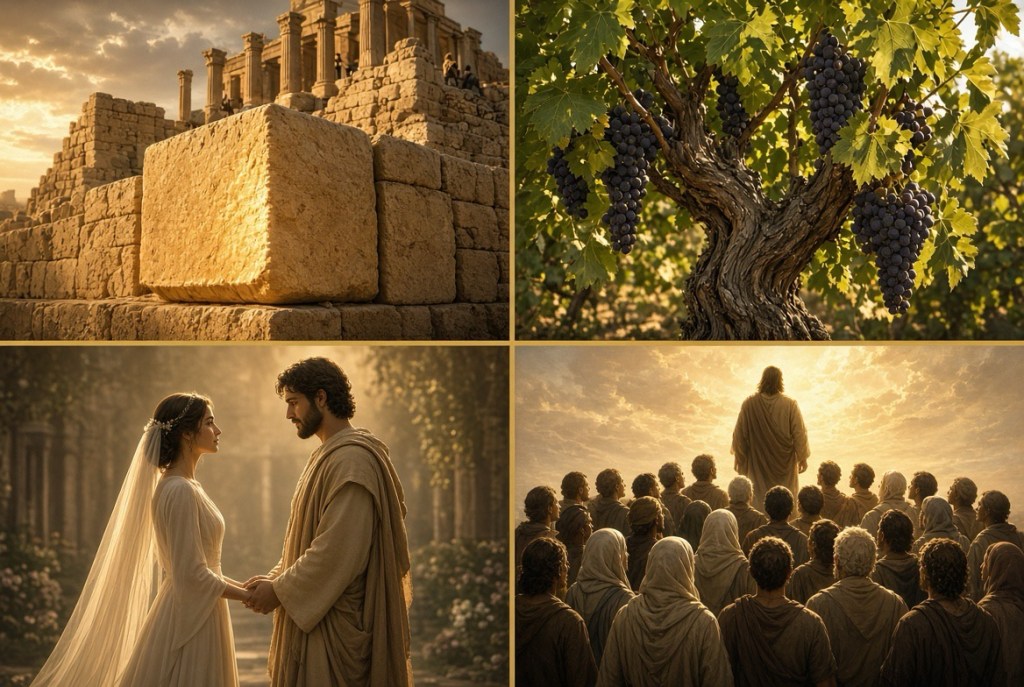
Doctrine needs pictures. Scripture does not leave union with Christ as an abstract claim. It gives us metaphors so we can gaze at the beauty of the reality. This week we lingered over four of them: a building, a vine, a marriage, and a body.
1. The Building: Stones on the Cornerstone
Ephesians 2:19–22 “So then you are no longer strangers and aliens, but you are fellow citizens with the saints and members of the household of God, built on the foundation of the apostles and prophets, Christ Jesus himself being the cornerstone, in whom the whole structure, being joined together, grows into a holy temple in the Lord. In him you also are being built together into a dwelling place for God by the Spirit.”
We are not loose stones scattered across a field. We have been cut and set. Our citizenship, our household membership, our place in the temple, and our life as a dwelling place for God all depend on being joined to Christ the cornerstone. MacArthur and Mayhue press the image:
“As each stone is cut precisely to fit snugly, strongly, and beautifully with every other part and to rest perfectly on the foundation, so also does the unity and stability of the church depend on Christ, her foundation. It is only by being built on and permanently united to Christ, our cornerstone, that believers find their spiritual existence, support, and security to be well-founded.” — John MacArthur and Richard Mayhue, Biblical Doctrine
Union with Christ is therefore personal and corporate at the same time. Each believer rests on the cornerstone. Together we are being built into a holy temple. If the stone is separated from the foundation, it has no spiritual existence, support, or security left.
2. The Vine: Life That Cannot Be Self-Generated
John 15:4–5 “Abide in me, and I in you. As the branch cannot bear fruit by itself, unless it abides in the vine, neither can you, unless you abide in me. I am the vine; you are the branches. Whoever abides in me and I in him, he it is that bears much fruit, for apart from me you can do nothing.”
This is not a metaphor of mere association. It is a metaphor of shared life. The branch does not visit the vine on weekends. The branch lives only because the vine’s life is in it. A. W. Tozer names both the legal and the vital sides of that relationship:
“A Christian is one who has been judicially, legally made a brother of Jesus Christ and a child of God. But he is more than that. He is one who has been vitally united to Jesus Christ by the power and motions of life so that he is vitally, livingly related to Jesus Christ. … The life of the vine is in the branch and the life of the branch comes from the vine, and the two are united. That’s a vital relationship.” — A. W. Tozer, “The Deeper Spiritual Life #4: Our Relationships to God”
We are legally made brothers of Christ and children of God. That would already be mercy beyond measure. But we are more than that. We are vitally, livingly related to Jesus. Fruit is not a self-improvement project. Fruit is the overflow of abiding. Apart from Him we can do nothing—not “very little,” nothing.
3. The Marriage: A Mystery More Near Than Earthly Wedlock
Ephesians 5:31–32 “‘Therefore a man shall leave his father and mother and hold fast to his wife, and the two shall become one flesh.’ This mystery is profound, and I am saying that it refers to Christ and the church.”
Paul is not using marriage to decorate a sermon. He is saying that the one-flesh union of husband and wife is a signpost pointing beyond itself to Christ and the church. Charles Spurgeon lingers over the nearness of that bond:
“There is, superadded to the natural union of Christ with His people, a mystical union by which He assumes the position of Husband, while the Church is owned as His bride. … Passing all human union is that mystical cleaving unto the Church, for which Christ did leave His Father, and become one flesh with her. … This affinity as it is more lasting, so is it more near than earthly wedlock.” — Charles Spurgeon, “Union to Christ,” The Sword and the Trowel (September 1865)
Christ left the glory of His Father’s presence not to sample a relationship, but to cleave to His people. The church is owned as His bride. The affinity is more lasting than earthly marriage and, Spurgeon says, more near. That is why unfaithfulness to Christ is never a small thing, and why His faithfulness to us is never a cold contract.
4. The Body: A Chosen Head and Living Members
1 Corinthians 12:12–13 “For just as the body is one and has many members, and all the members of the body, though many, are one body, so it is with Christ. For in one Spirit we were all baptized into one body—Jews or Greeks, slaves or free—and all were made to drink of one Spirit.”
The body metaphor does more than teach teamwork. It teaches representation. What is true of the Head is counted as true of the members. MacArthur and Mayhue draw that line with care:
“This metaphor lays the groundwork for understanding the legal and representational nature of the believer’s union with Christ, where Christ obeys (Rom. 5:18–19; cf. 1 Cor. 1:30), dies (Col. 2:20), rises (Col. 3:1), and ascends (Eph. 2:6) in their place, such that they are reckoned to have done all those things. Because this union is a legal union—that is, because Christ is the representative head of his people—there is no element of Christ’s earthly life, death, burial, resurrection, and ascension in which the believer does not partake on account of being in him.” — John MacArthur and Richard Mayhue, Biblical Doctrine
If you are in Christ, His obedience is yours. His death is yours. His resurrection is yours. His ascension is yours. There is no part of His saving work from which the believer is excluded. Spurgeon turns the same truth into worship:
“A chosen Head, therefore chosen members; an accepted Head, therefore accepted members; a living Head, therefore living members. If the Head be pure gold, all the parts of the body are of pure gold also. … Pause here, devout reader, and see if you can contemplate the infinite condescension of the Son of God in exalting your wretchedness into blessed union with His glory. … Let the poorest and most despised believer take hold upon this privilege … this glorious, heavenly honour of union with Christ.” — Charles Spurgeon, Morning and Evening, December 6 morning
The poorest believer, the most overlooked member of the body, shares the honor of the Head. If He is chosen, we are chosen. If He is accepted, we are accepted. If He lives, we live. Gold in the Head means gold in the members—not because we manufactured holiness, but because we are united to Him.
One Big Application: Meditate Until It Becomes Attachment
The study did not end with a list of ten things to do this week. It ended with one large application: meditate on this reality. Let it sink into you. Let it drive you to an emotional attachment to Christ.
That application is not a retreat from mission. It is the fuel of mission. We exist for three reasons:
- To embrace the love of God shown to us through His Son Jesus.
- To engage our community through service and through prayer.
- To follow the Lord as He leads us, taking the gospel, living our lives on mission, from the neighborhoods of Oakland all the way to the nations of the world.
Embrace comes first. We cannot engage or follow with any lasting joy if we treat union with Christ as a doctrine we merely admire. Tozer would not let his hearers stop at a correct paragraph in a systematic theology:
“The Spirit of God has impelled me to preach and write much about the believer’s conscious union with Christ—a union that must be felt and experienced. I will never be through talking about the union of the soul with the Savior, the conscious union of the believer’s heart with Jesus. Remember, I am not talking about a “theological union” only. I am speaking also of a conscious union, a union that is felt and experienced.” — A. W. Tozer, “United with Christ,” in Mornings with Tozer
He pressed still further. The Christian who actually lives in this reality is not playing at religion. He is acquainted with God:
“[The evangelical mystic] exists in a world of spiritual reality. He is quietly, deeply, and sometimes almost ecstatically aware of the Presence of God in his own nature and in the world around him. His religious experience is something elemental, as old as time and the creation. It is immediate acquaintance with God by union with the Eternal Son. It is to know that which passes knowledge.” — A. W. Tozer, Introduction to The Christian Book of Mystical Verse
Spurgeon closes the week the way the week should close—not with theory, but with a sentence that can be said in the dark:
“Of God are ye in Christ. You have no life before the Lord, except as you are in Christ Jesus. … I trust, brethren, that we are in union with Christ, not in theory, but in fact; not as a matter of doctrine, but as a matter of experience, till we can say, “Christ is in me, and I am in him; the life that I live in the flesh is no more I, but Christ that liveth in me.”” — Charles Spurgeon, compiled in “Spurgeon on Union with Christ,” The Spurgeon Library
Carrying Week 3 Forward
If Colossians 1:1–8 shows us a gospel that is received, loving, hopeful, global, fruitful, gracious, and reported, then union with Christ shows us why that gospel can actually change a church. The Colossians were not impressive because they had discovered a new technique. They were saints and faithful brothers in Christ. Their life was hidden with Christ in God. Christ was in them, the hope of glory.
So this is the work of the coming days. Read the four metaphors slowly. Say the prepositions out loud: into Christ, in Christ, Christ in you. Refuse to leave the truth in the notebook. Ask the Spirit to make the union conscious—not as a private spiritual high detached from Scripture, but as intelligent communion with the crucified, risen, and present Lord.
We have no life before the Lord except as we are in Christ Jesus. That is not a threat. It is the safest sentence a Christian can learn to love. He is the cornerstone. He is the vine. He is the Husband. He is the Head. And because we are united to Him, we may take hold of this privilege—the poorest of us, the most ordinary of us—this glorious, heavenly honor of union with Christ.
Let the word of Christ dwell in you richly. Colossians 3:16
 Immerse Bible Study
Leave a comment